
In a live game, the hardest part is usually the question that comes after a number moves. If content participation drops, which players changed? If a paying player leaves, where do you start looking? If you ship a fix, did play actually change? Each answer means checking the data, weighing the possible explanations and deciding what to do next, and a small team has to do all of it too.
At UNDERDOX, six people do this work. The studio built the 4X strategy game Polaris: Crown Legacy in about six months, operates and tests it directly in selected Southeast Asian markets and is developing a new MMORPG. UNDERDOX connected role-specific agents to the data it collects in ThinkingAI, so questions and analysis carry through to real operating decisions.

One question used to move through nine teams
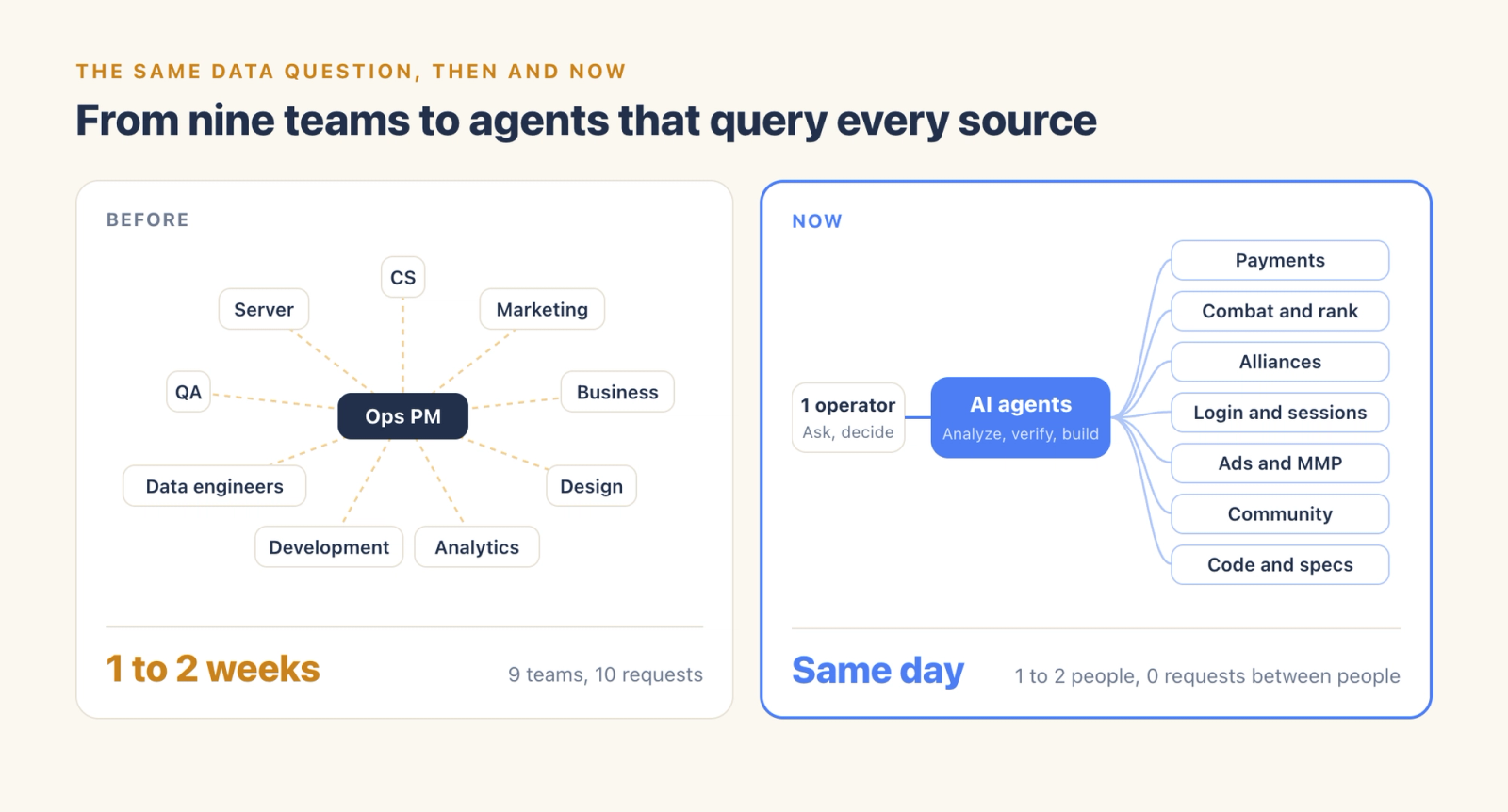
At a large studio, answering "Why did this player leave?" takes many people. Analysts find the data, engineers check the logs, and confirming a payment or login issue takes help from other teams. Even after the analysis is done, the findings still have to reach design and development. In UNDERDOX's earlier way of working, one data question passed through nine teams and took one to two weeks to answer.
Today one or two people get an answer to the same kind of question on the same day. Agents query the data sources the question needs and carry the analysis forward, so nobody has to pass requests from team to team. The team's role changed as well. People spend less time requesting and collecting data and more time deciding what to check and judging the results.
Find where the change happened before reading the average
Polaris adds several minigames every week. To judge whether that content deserved continued investment, UNDERDOX looked at participation rates. At first, participation seemed to vary by country, ad channel and ad creative, which suggested that each acquisition source might be bringing in a different kind of player.
Changing the comparison base opened up a different reading. Measured against players who had reached the level where minigames unlock, the gap between countries shrank sharply. The countries had different shares of new players who had yet to reach that level. In the presentation's illustrative figures, participation ranged from 26% to 54% of logged-in players, and from 86% to 91% of players at the unlock level in every country.
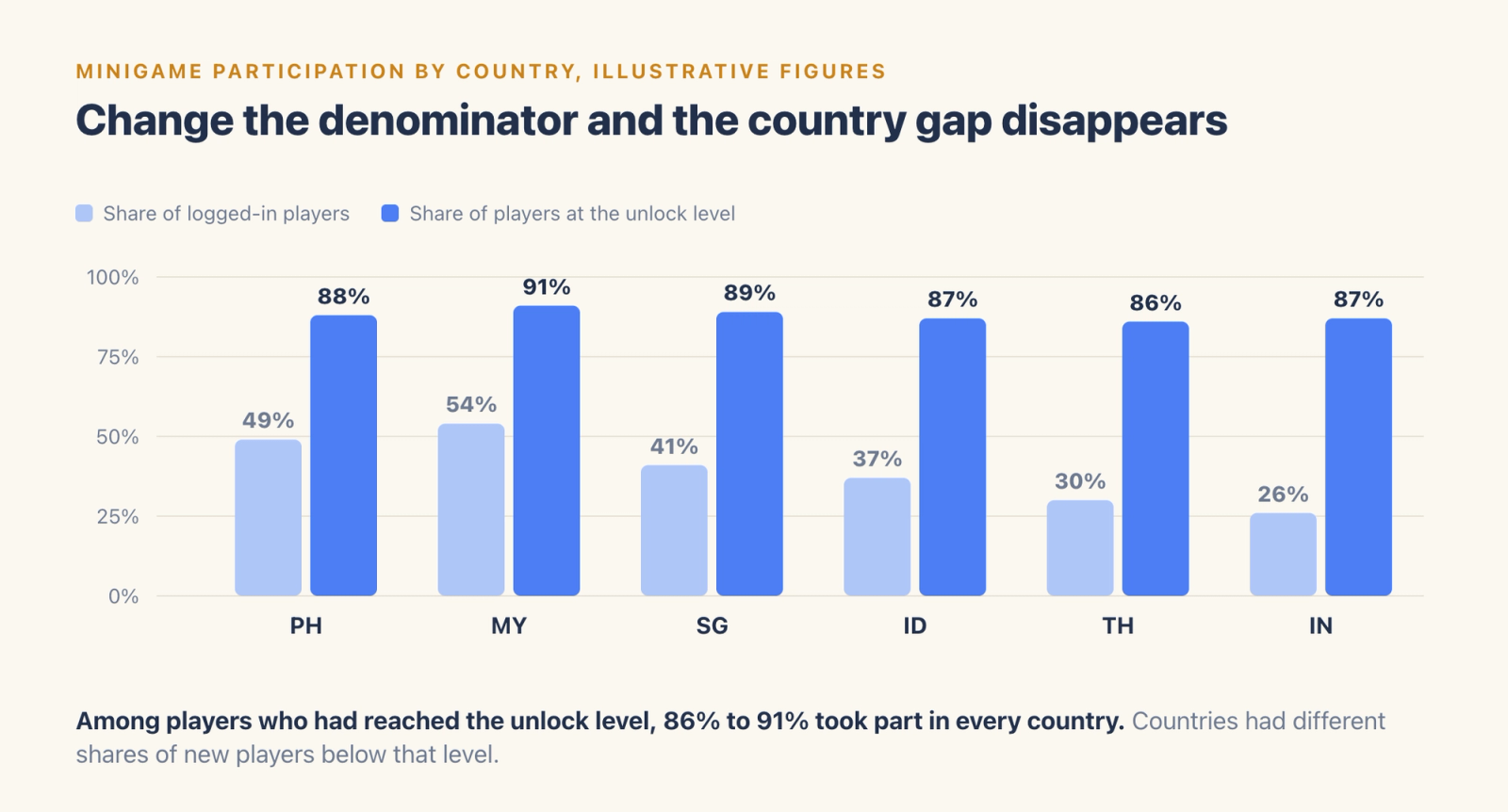
That finding changed the next decision. UNDERDOX kept making minigames and kept one experience for every country, and chose to refine early progression so more players reach the content. The key step was separating players by how far they had progressed, a difference the overall average hid, and choosing the right comparison.
From one player's churn to a hypothesis worth checking
Another analysis began with a short question. "Why did high-spending Player A leave?"
Player A reached the top ranks of the server soon after joining. After an attack during castle defense, Player A lost 46% of their combat power in one day, logged in less and less, and then left the game. That record alone leaves the cause open, since another problem could have come up after the battle. UNDERDOX looked at payment, combat, alliance and login data together and examined one hypothesis, that the burden of rebuilding the lost army may have been tied to the churn. A verification agent also checked whether other explanations, such as payment errors, could account for it.
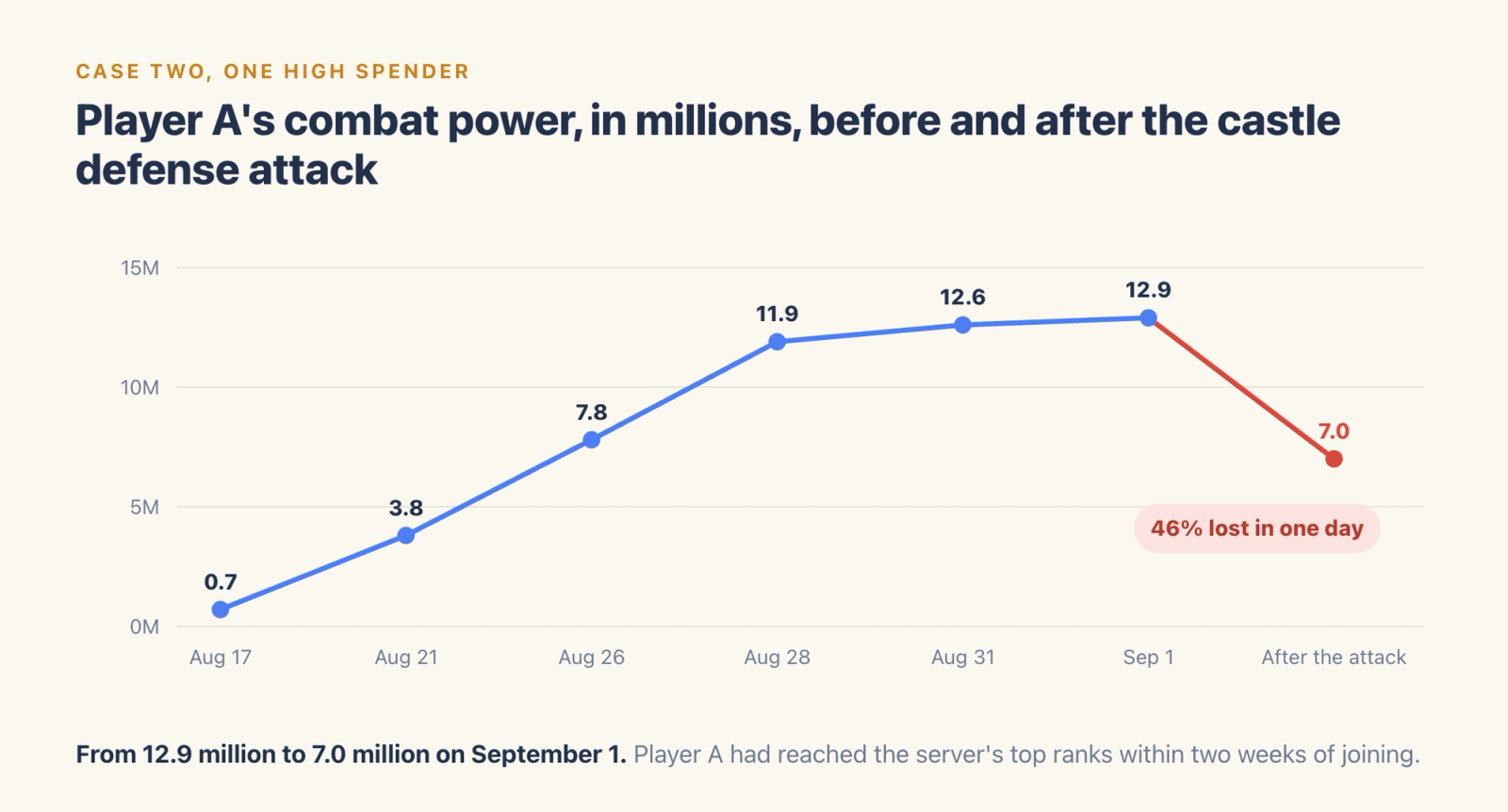
Then the team widened the question. Did other players hit by the same kind of attack also leave? Extending one player's experience to everyone with comparable losses revealed the same churn pattern after heavy troop losses. The team could now see more clearly which players and which situations needed a fix.
The next step after the analysis was a content design
UNDERDOX chose to ease the burden of rebuilding through game design. The answer was the Temple, new content that brings back part of the fallen troops over time, so a defeat feels like something a player can recover from. From identifying the problem to finalizing the Temple design took three days. Implementation and deployment followed as separate steps. UNDERDOX says that after the update, players attacked in the same pattern rebuilt their troops and stayed in the game.
Players staying after the update is an observation, and it falls short of proof that the Temple caused it. The presentation includes no control group or A/B test results, so confirming the effect would take a comparison group. What the case does show is a single flow, from spotting one player's churn, to checking whether the problem recurs, to a content change.
Accurate data and analytical know-how came first
First, the payment, combat, alliance and login data had to be accurate and in one place, and the team needed the know-how to decide how to analyze it and which other explanations to check.
Agents can do this work because the data is already accurate and together in one place.
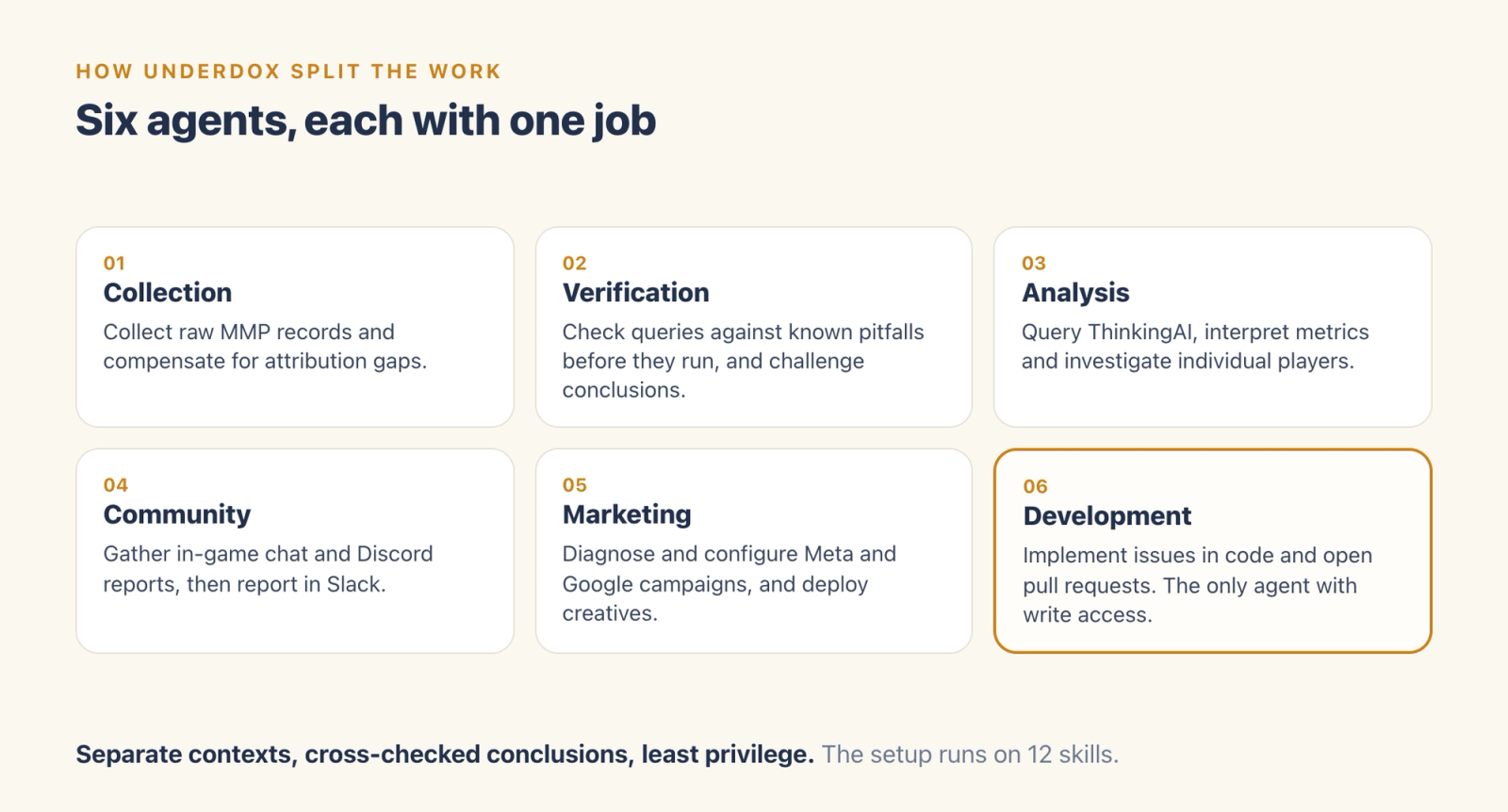
ThinkingAI provides the foundation that collects behavioral data accurately in one place, along with player-analysis skills that agents can use. On top of that, UNDERDOX built its own role-specific agents, a knowledge repository and a development pipeline. The work is split across six agents for collection, verification, analysis, community, marketing and development, so the agent that runs an analysis is separate from the agent that checks its conclusions, and only the development agent has write access. Analysis runs read-only, and changes made by the development agent go in as pull requests that people review and approve. The decision on what to change stays with people.
Each analysis starts where the last one ended
UNDERDOX keeps the mistakes it finds during analysis and turns them into checks. User-initiated payment cancellations stay out of error counts, several accounts on one device are told apart, and server and client times are aligned before any comparison. The team has collected 161 pitfalls this way, along with 66 reusable procedures and saved queries. When a similar problem comes up, the team can start from the procedure and criteria it used before, which makes it less likely that the next person falls into the same trap or solves the same question from scratch. What builds up is the team's knowledge of what to check next.
How far your team could take this
Four changes stand out in the UNDERDOX story.
- The team narrowed past the overall average to the players and situations where the change appeared.
- It framed possible explanations as hypotheses and checked the alternatives.
- It turned analysis results into a specific content change.
- It kept the pitfalls and procedures it found as knowledge for the next analysis.
Every team will build this differently. How far a team can connect the steps depends on its data, its integrations, its execution and deployment capabilities, and its permissions. UNDERDOX designed its own agents and development flow on top of ThinkingAI's data and analysis foundation. A good first check is whether your data already filters out test devices, alt accounts and reinstalls, and whether the agents that verify conclusions are separate from the ones that draw them.
For your team, start with which questions your data can answer, how those answers can turn into action, and how you will verify the results and keep what you learn.
What matters more than size is the knowledge that accumulates and the speed at which you ask questions.
Based on Min-seok Kang's UNDERDOX presentation at ThinkingAI Summit Seoul 2026 (TAS26). The real player nickname is anonymized as Player A.
“When we move beyond using AI individually and integrate our work through AI, even a small team can handle data like a large company.”